Iranian officials rally behind Leader's directive for unity and resistance
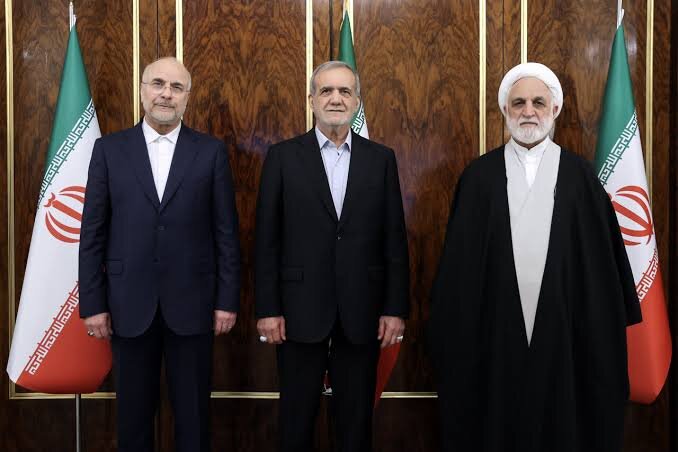
TEHRAN — Iran’s executive, legislative, judicial, and national security leadership have responded with unified endorsement following the major strategic address delivered by the Leader of the Islamic Revolution, Ayatollah Seyyed Mojtaba Hosseini Khamenei.
In a series of coordinated statements, top officials across all branches of governance described the Leader’s annual Government Week message as an indispensable, comprehensive blueprint for defending national sovereignty, countering hostile economic blockades, and safeguarding domestic social cohesion.
Leading the domestic response, the administration of President Masoud Pezeshkian issued a formal statement on Saturday expressing its profound appreciation for the "wise guidance" of Ayatollah Khamenei. The cabinet noted that the Leader’s words have brought "joy, encouragement and hope" to officials serving the Iranian public during a period of complex national challenges.
Describing the Leader's confidence and support as "the greatest asset and source of support," the administration affirmed that while it fully recognizes the economic pressures stemming from foreign sanctions and recent imposed wars, its immediate priority remains addressing interconnected economic challenges. The government outlined plans to focus on controlling inflation, managing domestic markets, generating employment, directing investment toward domestic production, and steadily reducing reliance on the US dollar.
"We commit ourselves to ensuring prosperity and improving the livelihoods of our dear people in a manner worthy of their dignity," the cabinet statement read, reiterating its full adherence to resistance-economy principles and reliance on internal capabilities.
The administration also identified the preservation of national unity as an absolute priority. In direct response to the Leader’s directive against divisive political conduct, the executive branch confirmed that every major political, economic, social, and cultural decision going forward will incorporate a mandatory "national cohesion component."
"We consider avoiding artificial polarization and discouraging statements to be our definite duty," the statement added, pledging to devote all state efforts toward strengthening consensus, solidarity, and hope across Iranian society. On foreign policy, the administration emphasized that Iranian diplomacy will continue to operate on the guiding principles of "dignity, wisdom, and prudence," promising to firmly resist foreign sanctions and the "unjust schemes of US-Israeli arrogance" through heightened coordination between diplomatic and defense sectors.
Echoing the executive branch, Judiciary Chief Gholam-Hossein Mohseni Eje’i described the Leader’s message as a roadmap for all government officials and servants of the state. He emphasized that strict adherence to the Leader’s guidance represents the only viable path to successfully overcoming current historical challenges.
“The Leader’s enlightening message is a roadmap for all officials and servants of the system and the people,” Mohseni Eje’i stated, underscoring the critical importance of strengthening national unity and rejecting any discourse that could cultivate division. “We reject any form of discord and division in this challenging and eventful path.” He added that from a revolutionary perspective, the unbreakable bond between the Iranian public and the leadership constitutes an “impenetrable barrier” against enemy hybrid warfare.
In the legislative realm, Parliament Speaker Mohammad-Baqer Qalibaf similarly declared that the Leader’s message must serve as the primary guiding principle for all state authorities. Writing in a post on X, Qalibaf emphasized that avoiding actions that could damage social solidarity is both a strategic and moral mandate. “Any action that harms social cohesion is, for all of us, both a national and religious prohibition,” Qalibaf stated. “We pledge to the people and the Leader that, to the very end, we will devote ourselves to serving the people and advancing Iran.”
Concurrently, Iran’s top security official, Mohsen Rezaei, affirmed that the Leader’s remarks “constitute a clear and unequivocal strategy for everyone.” Rezaei stressed that in the current geopolitical environment, “national unity and social cohesion are among the most fundamental components of national power and security.”
The unanimous alignment among senior Iranian leadership follows the address delivered on Friday by Ayatollah Seyyed Mojtaba Khamenei to mark Government Week—an annual period held to commemorate President Mohammad Ali Rajai and Prime Minister Mohammad Javad Bahonar, who were assassinated in the bombing of the prime minister’s office on August 30, 1981.
In his message, the Leader honored the memory of the martyred presidents Rajai and Ebrahim Raeisi, the martyred prime minister Bahonar, and all martyred employees, managers, and ministers of various administrations. He paid special tribute to "the great martyr Leader Ayatollah Seyyed Ali Khamenei, who held the office of president for nearly two terms."
Ayatollah Khamenei expressed his deep appreciation for the active employees and managers of government institutions, offering specific praise for "the sincere and caring" President Pezeshkian.
“In particular, I commend the worthy measures they have taken, despite the various restrictions and plots of the American-Zionist enemy, and the intensification of sanctions and blockades, during the third imposed war and afterward, to ensure the provision of goods and various services needed by the people, repair key damaged areas, and manage energy,” the Leader stated.
He stressed that the nation of Iran, having “demonstrated its true mettle” over the past six months amid US-Israeli aggression, is fully entitled to feel the concrete services rendered by the various branches of the administration.
Turning to economic governance, Ayatollah Khamenei addressed a chain of livelihood challenges, including inflation, emphasizing the need to focus on core economic pillars. He explicitly called for “boosting production, gradually phasing out the dollar from its important role, and ultimately placing the entire set of resistance-economy policies at the center.”
“The key to resolving all these matters in this field lies in relying as much as possible on domestic production,” the Leader stressed, noting that where domestic capacity is insufficient, imports must be managed "properly and wisely."
These remarks come at a time when the United States has launched a broad initiative titled “Operation Economic Outcast,” following Washington's failure to achieve its broader war objectives against Iran. Addressing these external pressures, the Leader noted that while enemy conduct during and after the war is not without effect, "ever-smarter management of the components of this field, seeking the assistance of the people and experts, and bringing new capacities into operation will guide the country toward the expansion of affairs and development."
Warning against falling into foreign psychological traps, Ayatollah Khamenei highlighted: “The sworn enemy of this nation tries to convey that the path to development and progress lies in following it and complying with its unreasonable demands; whereas observing what it has done to this country and its resources in past periods, even years before the Islamic Revolution, shows otherwise.”
As a key driver for future growth, the Leader urged the “application of technologies and innovations proposed by young elites.” He observed that making timely use of these technological advantages and stepping away from routine procedures and established habits can trigger effective leaps in the country’s overall advancement.
Leave a Comment