Is Kushner pursuing negotiations or his own interests?
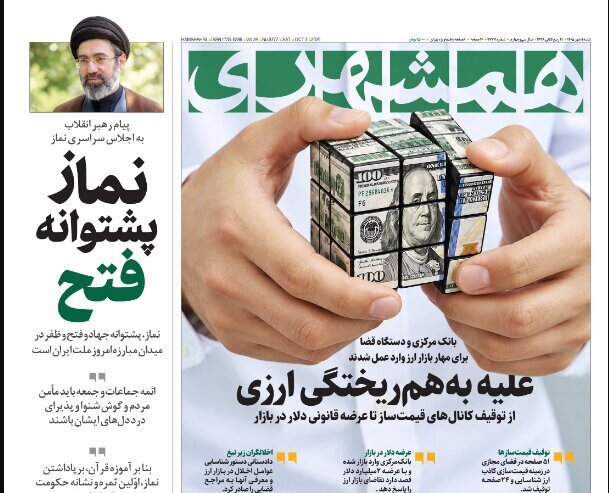
In a note, Hamshahri examined the cooperation between Kushner’s investment company and Israeli entities. While Kushner has been active in advancing Trump’s Middle East policies and negotiating regional disputes, including those involving Iran, his investment firm has indirectly invested in some companies linked to Israel’s military industry through its stake in an Israeli financial institution.
Investigations indicate that Kushner’s firm has become one of the largest shareholders in this Israeli institution while he has simultaneously played a role in negotiations concerning the end of the Gaza war and other Middle East issues, including Iran. The institution’s investment portfolio includes companies that supply equipment used by the Israeli military in conflicts in Gaza, Lebanon, and Iran. The case illustrates the connections between private capital, Israel’s defense industry, and US diplomacy in a region already strained further by the Iran-Israel conflict.
Donya-e-Eqtesad: Washington’s response on Tehran’s table
Donya-e-Eqtesad analyzed Tehran’s seven-day proposal and the current US approach. The US response to Iran’s seven-day proposal was reviewed in Tehran on Wednesday, marking a new phase in negotiations that are now focused less on the substance of an agreement and more on the sequencing of commitments, mutual guarantees, and the degree of flexibility shown by each side. These issues could determine the future trajectory of diplomacy. Receiving Washington’s response should not by itself be interpreted as a sign that an agreement is imminent. Even if a new understanding is reached, it would not necessarily resolve the fundamental disputes between Iran and the United States. Therefore, the newspaper considers the most likely short-term scenario to be continued intensive diplomacy and phased agreements aimed at crisis management. Such arrangements may temporarily reduce tensions, but a durable solution would require more substantial changes in the positions of both sides.
Jam-e-Jam: Netanyahu plans to drag Trump into a new crisis with Iran
Jam-e-Jam evaluated what it described as an alleged plot involving the hijacking of an Israeli-bound aircraft. The newspaper claimed that the objective of such an operation would be to force Trump into a new confrontation and potentially another war with Iran. Netanyahu is deeply concerned about his political future and fears that, if elections for the Knesset were held under current conditions, his coalition would fail to secure a majority and form a government. Netanyahu hopes to use his influence over the White House and Trump to draw the United States into another large-scale conflict, thereby using American military power, economic resources, and international standing to improve his domestic political position. Iran is closely monitoring American and Zionist activities and is prepared to respond decisively to any hostile action by Israel or the United States.
Ham-Mihan: Why did Trump reject Iran’s proposal?
Ham-Mihan examined the reasons behind Trump’s rejection of Tehran’s seven-day proposal. The newspaper wrote that Trump initially rejected the offer, arguing that Iran was seeking a quick agreement to end Washington’s economic pressure campaign while under significant strain. From Trump’s perspective, accepting the proposal could have created the impression that, after incurring military and political costs and enforcing economic pressure, the United States had been compelled to offer economic concessions in order to reopen the Strait of Hormuz. Instead, Trump reportedly seeks an agreement that can be presented not as a new version of the JCPOA, but as a stricter arrangement in which Iran first accepts verifiable nuclear restrictions and only afterward receives sanctions relief. Some experts on Iran- US relations believe that if Washington continues to demand nuclear concessions before taking any economic steps, the seven-day initiative may represent not the beginning of an agreement but the final diplomatic effort before a new phase of escalation.
Iran: Iran’s multi-layered nuclear file
The Iran newspaper assessed the 70th General Conference of the International Atomic Energy Agency (IAEA). According to the paper, the conference represented a confrontation between two different logics: the logic of institutions and the logic of politics. Under the institutional logic, formal mechanisms still allow participation, voting, dialogue, and multilateral cooperation. Under the political logic, however, power dynamics, national interests, and the security environment surrounding major issues strongly influence outcomes. The newspaper added that a third layer, the media dimension, shapes how public opinion interprets events. It argued that the significance of Vienna lies precisely in the interaction of these three layers: Iran’s nuclear file is no longer merely a technical issue but a complex, multidimensional matter that interconnects law, diplomacy, security, safety, and media. The recent Vienna meeting, therefore, should be viewed not simply as an annual conference but as a condensed reflection of the current state of nuclear diplomacy, where maintaining a place within international mechanisms, managing political disagreements, preserving technical channels, and presenting accurate, well-documented narratives have all become equally important.
Leave a Comment