Shadow of Hormuz Strait on US midterm elections
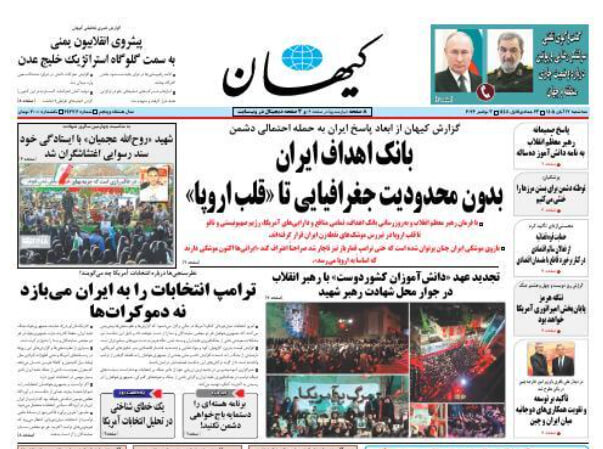
Kayhan argued that issues related to Iran and the Strait of Hormuz have become a significant factor in the American midterm elections. According to the newspaper, the elections are taking place at a time when economic concerns linked to regional tensions are attracting considerable public attention in the United States. Based on polling trends, the paper suggested that Democrats are likely to secure a majority in the House of Representatives.
It said that one of their strongest advantages against President Trump is what it describes as his failure to confront Iran. The article further argued that the continued pressure associated with developments around the Strait of Hormuz has affected economic conditions and living costs in both the United States and Europe. As a result, the paper maintained that Iran-related developments have turned into one of the central political issues influencing public debate and voter behavior during the election season.
Iran: Tehran s appropriate approach to new conditions
The Iran newspaper examined the country s position within a rapidly changing regional order. It argued that recent developments, particularly the conflicts that have reshaped regional dynamics, demonstrate the need for a reassessment of Iran s role and responsibilities. According to the article, making effective use of Iran s geopolitical advantages, reinforcing strategic partnerships, and expanding cooperation with regional and international actors could help strengthen national interests and preserve the country s influence. The paper emphasized Iran s strategic location, especially its proximity to the Strait of Hormuz, as well as the importance of diversifying trade and transit routes. It also highlighted stronger diplomatic and economic engagement as essential tools for maintaining influence. However, the article stressed that successfully using these opportunities requires a precise understanding of structural changes occurring across the region and the adoption of policies that reflect new political realities and evolving balances of power.
Khorasan: Smart nuclear approach needed
In an article, Khorasan discussed the debate surrounding the possibility of Iran developing a nuclear weapon. The newspaper argued that Iran s rivals carefully monitor any activity related to weapon production or highly enriched uranium and remain ready to respond to such developments. It suggested that potential vulnerabilities in security and intelligence structures could make any attempt at weaponization easier to detect. According to the article, this would reduce the risks associated with military action for Iran s adversaries and potentially increase the likelihood of preventive measures. The paper emphasized that the major issue is not the technical capability itself but the risks involved in pursuing such a course under current conditions. It therefore advocated strategic patience, arguing that restraint can increase uncertainty for opponents while preserving future options. In the newspaper s view, patience serves as a more effective approach than rushing toward a decision that could significantly raise tensions.
Jam-e-Jam: We have won the cognitive war
Jam-e-Jam focused on what it described as Iran s success in the field of cognitive warfare against the United States and Israel. The newspaper argued that influence over public opinion, political perceptions, and security calculations has become one of the most important dimensions of modern conflicts. According to the commentary, signs of uncertainty, division, and political disagreement can be observed within both American and Israeli societies. The paper said that these developments are reflected in political debates, election discussions, and public opinion trends. It also argued that Iran s performance in military, psychological, informational, and economic arenas has contributed to growing doubts among its enemies. The article maintained that disagreements over future policies, concerns about regional confrontations, and debates surrounding political leadership all indicate the effectiveness of Iran s approach. Consequently, it concluded that Iran has so far achieved a meaningful victory in the cognitive and psychological aspects of the broader confrontation.
Resalat: The West must become disappointed with Iran
Resalat addressed the long-standing tensions between Iran and the West. The newspaper argued that this dispute cannot be resolved either through Iranian surrender or through the expectation that Western powers will fundamentally alter their behavior. Instead, it maintained that meaningful change will occur only when the West concludes that Iran cannot be compelled to submit through economic pressure, military force, political influence, psychological campaigns, or other forms of coercion. According to the article, Iran should reach a position where its existence, interests, and independence are accepted as undeniable realities. The newspaper suggested that Western governments must ultimately recognize that they cannot eliminate Iran, absorb it into their preferred political framework, or break its political will. Once that understanding takes hold, the paper argued, relations could gradually move away from a model based on pressure and domination and toward a more stable framework grounded in pragmatic calculations, mutual recognition, and acceptance of political realities.
Leave a Comment