Mehr Media Group CEO calls for stronger SCO media cooperation in Bishkek
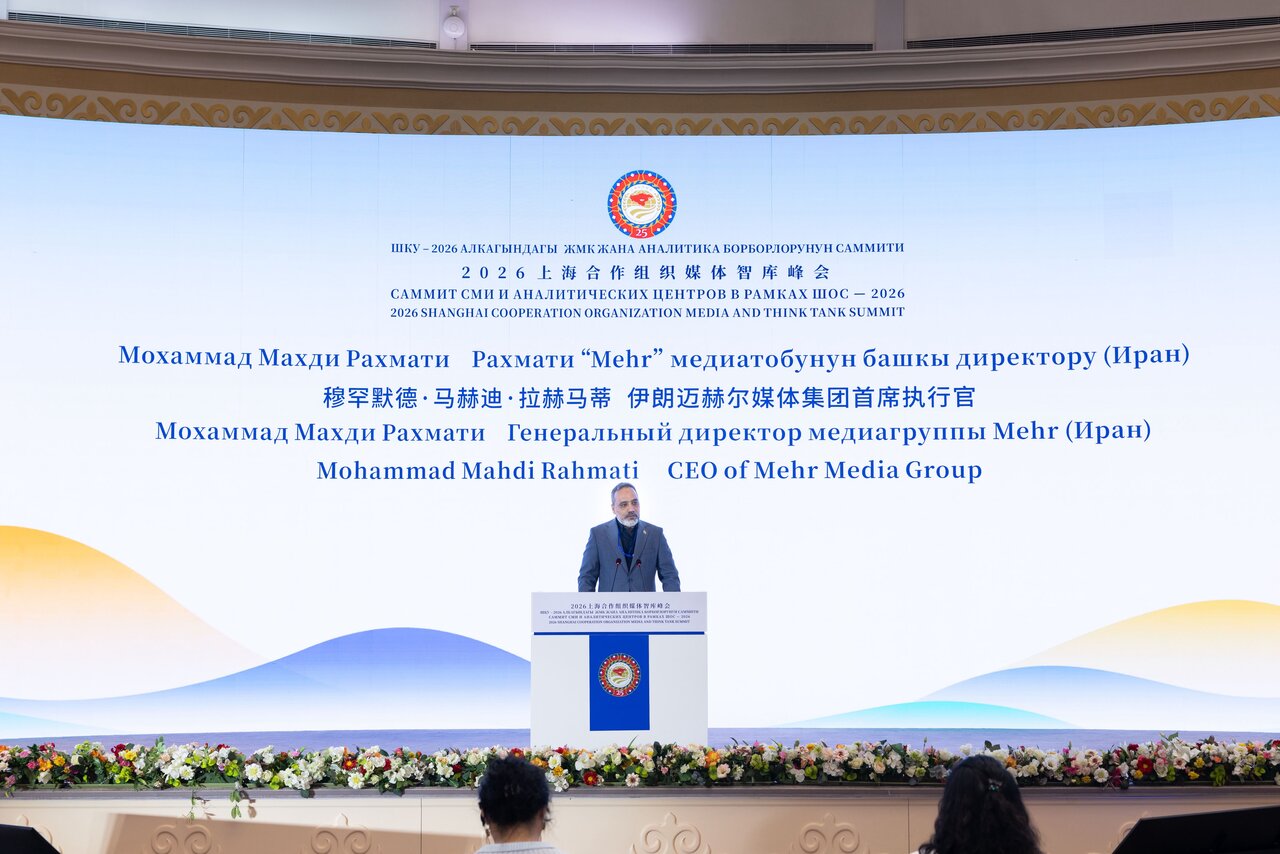
TEHRAN- Mohammad Mahdi Rahmati, the CEO of Mehr Media Group (which consists of Mehr News Agency and English-language daily Tehran Times), delivered the following speech at the Shanghai Cooperation Organization (SCO) Media and Think Tanks Summit in Bishkek, Kyrgyzstan on Monday.
He outlined proposals to deepen cooperation among the media and think tanks of SCO member states. His remarks focused on strengthening intelligent media collaboration and countering misinformation through greater regional engagement.
The full text of his speech is published below.
“Your Excellencies, esteemed colleagues, dear friends,
Distinguished participants in the Shanghai Cooperation Organization Media and Think Tanks Summit in Kyrgyzstan,
Good day.
I am deeply pleased and honored that we have gathered in the historic city of Bishkek, at the heart of the Silk Road, to discuss the role of media in the future of the SCO. Undoubtedly, this meeting is the result of the valuable efforts of many stakeholders, especially Xinhua News Agency under the leadership of my dear friend Mr. Fu, who in recent years has played a distinguished role in media synergy within the Shanghai family and beyond. In recognition of these valuable efforts, I sincerely pay my respects to Ms. Xi, deputy head of Xinhua, who is present at this Summit. I would also like to express my heartfelt gratitude to our esteemed host, the government and people of Kyrgyzstan, for their warm hospitality in this ancient land.
Kyrgyzstan is the land of the magnificent epic "Manas;" an epic line that says: "From among small birds I raised a golden eagle." This line contains the essence of our thought: unity and solidarity can transform scattered forces into a great power, and this is the mission of the SCO in the present age.
I am pleased to say that today’s world is not a place where real nations and civilizations will fail and submit themselves to unilateralism and a unipolar order. I come from a land whose people have shown steadfastness against the enemy with all their being in recent months.
Many of our Shanghai member civilizations have been linked through the Silk Road. Two thousand years ago, Zhang Qian, an envoy of the Han dynasty of China, went west and opened the way for acquaintance between China and Central Asia. Persian caravans crossed the Pamirs and carried the light of thought and precious goods between East and West. Today, too, the spirit of Shanghai — mutual trust, mutual benefit, equality, consultation, respect for the diversity of civilizations, and the pursuit of common development — are the foundations for forming a shared perception that facilitates the development and purposeful guidance of member countries’ capacities along the right path.
Professor Sun Zhongzhi of the Chinese Academy of Sciences emphasized at last year’s Media and Think Tanks Summit in Zhengzhou that "in today’s international relations, perception has turned from an abstract concept into a key and influential factor in political realities." He rightly believes: "Think tanks should not only address current issues, but should also carefully analyze historical backgrounds, cultural contexts and social traditions so they can offer deeper and more forward-looking views and solutions." I add that building a "community of shared future for mankind" will be realized when think tanks, as explainers of theoretical foundations, and media, as disseminators of those foundations, create a new capacity for common understanding across the geography of member countries.
Today the world is full of misunderstandings and prejudices, and these "incorrect perceptions" sometimes create serious obstacles to trust and cooperation among SCO members. By providing objective and comprehensive reports, we can overcome obstacles rooted in historical, cultural and social backgrounds and build an accurate and positive understanding of one another. Today intelligent media is not merely an information platform, but a strategic capacity for convergence, conflict resolution, and realizing a "community of shared future for mankind" within the framework of the SCO.
Integrated intelligent media is not simply a new technology, but a systematic transformation in thinking, in the process of producing and distributing content, and in models of communicating with audiences. Such capacity can no longer belong to a single medium and requires networked governance. As the theory of network governance suggests, in today’s interconnected world effective governance is no longer possible through a single center, but requires information sharing and multilateral interaction among different actors.
To realize this vision, I propose four complementary steps, to be implemented with the cooperation of SCO members in the media field:
First: Establish the "Shanghai Media and Think Tank Joint Platform" — a digital, intelligent and integrated environment in which the media and think tanks of member countries can continuously exchange content, analyses and strategic data. This platform is not a one-way channel, but an interactive space for joint thinking among knowledge producers and media narrators so that a common perception of regional and global developments can be formed live and dynamically.
Second: Design and implement a periodic evaluation mechanism of the "degree of realization of the spirit of Shanghai" — transparent and participatory indicators drafted by think tanks and, with the help of intelligent media, periodically monitoring progress in mutual trust, respect for civilizational diversity and common development in public opinion and in member countries’ policies. The result of this evaluation is not for judgment, but for collective learning and course correction.
Third: Systematically introduce successful media and communication governance models within the Shanghai family — each member has valuable experience in integrating artificial intelligence into reporting, combating fake news, digital public diplomacy and building bridges between science and policy. I suggest forming a permanent working group under this summit to collect, document and share successful examples annually with members.
Fourth: Form a "permanent advisory network" to moderate wrongful actions based on shared understanding — using the same logic of network governance, integrated intelligent media and think tanks can, in a continuous process, identify prejudices and incorrect perceptions before they become political or security crises, and neutralize them by producing accurate, data-driven narratives.
Dear friends and colleagues, let us take a practical step from this historic meeting in Bishkek toward a "community of shared future for mankind." Let us create this golden eagle today, at this very summit, from our solidarity and make it the lasting symbol of the Shanghai family’s intelligent media.
Thank you for your attention, and I wish success to all members.”
Leave a Comment