Shipping security or the return of Western interventionism?
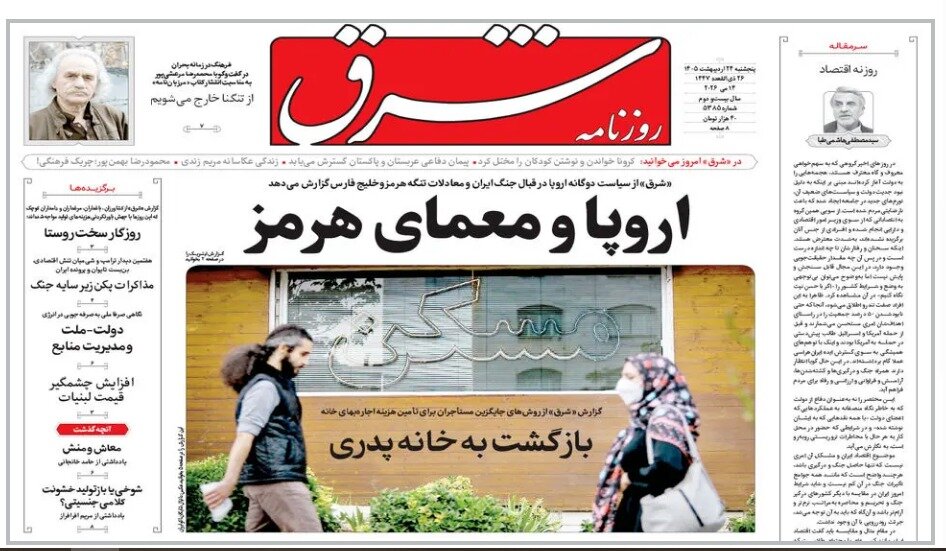
Shargh analyzed the coalition-building by London and Paris against Iran. Shargh writes that at a time when insecurity caused by the US-Israeli-imposed war on Iran — and the resulting escalation of tensions in the Persian Gulf — has placed Europe’s economy under greater pressure, the UK and France have launched a new effort to form a coalition in the Strait of Hormuz.
Critics argue that this move, rather than being a defensive measure, represents a gradual return of the West to an interventionist model of regional security. Although London and Paris have tried to portray this initiative as ‘‘defensive, independent, and limited,’’ the very act of forming a coalition to operate in one of the world’s most sensitive waterways is seen by Tehran as nothing more than an attempt to legitimize extra‑regional presence. The Islamic Republic of Iran has repeatedly emphasized that the security of the Persian Gulf and the Strait of Hormuz must be ensured by regional countries themselves, and that the involvement of external actors not only fails to contribute to stability but is itself a major driver of crisis escalation.
Farhikhtegan: A weapons festival featuring Pahlavi!
Farhikhtegan commented on Reza Pahlavi’s presence as a guest at Lockheed Martin, the world’s largest arms manufacturer. Until recently, Reza Pahlavi only verbally supported military attacks on Iran — even thanking Donald Trump for them. But now he has become a guest of the world’s biggest weapons manufacturer. Pahlavi is pleading for renewed and expanded US strikes on Iran. The US, in turn, buys more weapons for more war, and as always, its first choice is Lockheed Martin. More people in Iran are killed, and more money flows into the company’s accounts. Pahlavi’s special role is to act as a catalyst, accelerating the start of war in the region and against Iran, so that arms manufacturers can profit more. His share of this marketing effort is the promise of a return to the throne — a dream that, no matter how hard he tries, will never materialize.
Sobh‑e‑No: Why negotiation is the continuation of struggle
Sobh‑e‑No analyzed misunderstandings during wartime and negotiation. The paper wrote: In wartime, suffering is not only the result of fire and siege; sometimes it stems from misunderstanding the situation. When the battlefield and diplomacy are simultaneously generating power, some domestic voices, instead of accurately reading the balance of forces, either reduce politics to surrender or mask prudence with performative radicalism. Today, Iran’s negotiating team faces two internal groups that — despite speaking different languages — reach the same dangerous conclusion: discrediting national rationality. One group says, ‘‘Let’s give in and finish it,’’ as if politics were a marketplace for concessions. The other sees every negotiation text as betrayal and every act of prudence as capitulation. Both fail to understand politics. Our suffering comes not from negotiation itself, but from failing to understand its meaning under current conditions.
Ettelaat: Is Saudi Arabia seeking a security pact with Iran?!
Ettelaat commented on claims of a potential security agreement between Saudi Arabia and Iran. Saudi Arabia is reportedly consulting with its allies about signing a “non‑aggression pact” between regional countries and Iran. The idea — proposed by Riyadh — aims to manage regional tensions after the end of the US‑Israeli war with the Islamic Republic of Iran. Persian Gulf states, especially since the start of the war, have been concerned that once the conflict ends and the US reduces its large military presence, they may face an Iran that is wounded yet more assertive. Diplomats say many European capitals and EU institutions support Saudi Arabia’s proposal and are encouraging other Persian Gulf Arab states to back it as well. From their perspective, this plan is the best way to prevent future conflicts and to offer Tehran assurances that it will not be targeted.
Leave a Comment