Workshop on ‘Trauma for First Responders’ held in Tehran
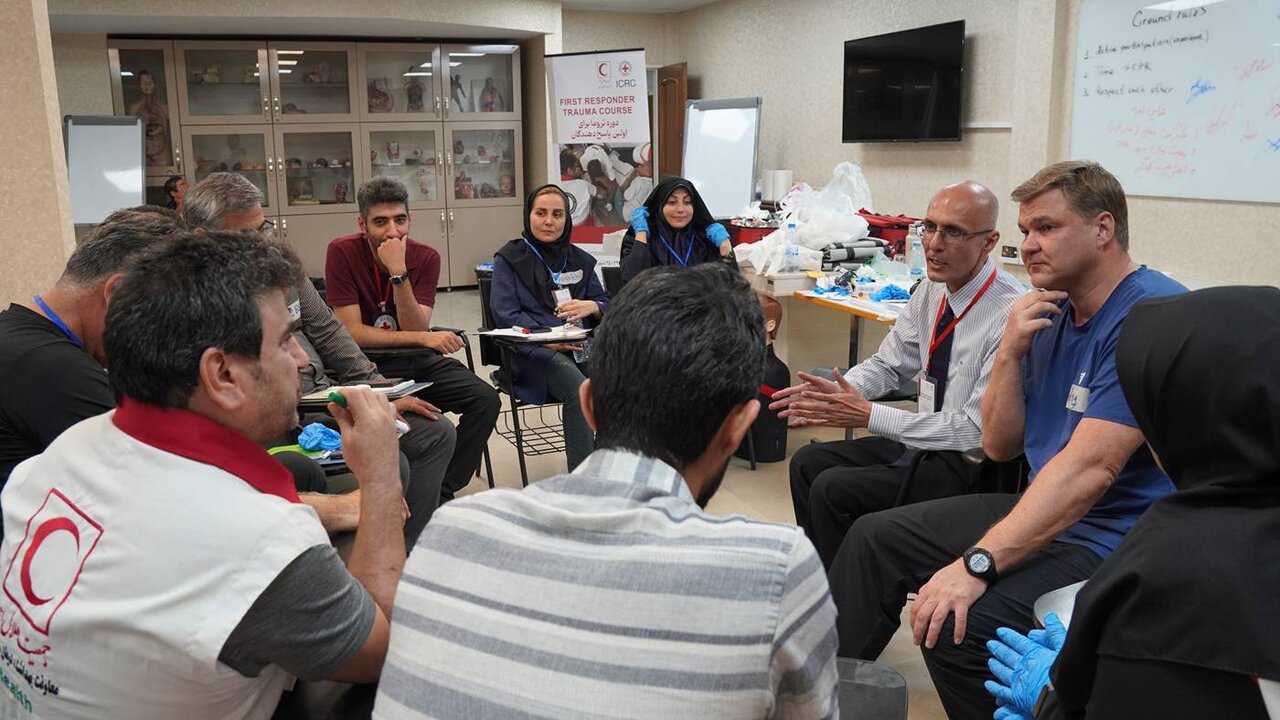
TEHRAN – The Iranian Red Crescent Society (IRCS), in cooperation with the International Committee of the Red Cross (ICRC), has held the first three-day training workshop on ‘Trauma for First Responders’ for selected IRCS personnel, with a focus on trauma and pre-hospital care.
The training aims to enhance the emergency response and pre-hospital care capacities of the IRCS personnel, particularly in mass-casualty incidents, to provide timely and effective lifesaving services and ensure the safe evacuation and transfer of injured and sick people, the ICRC website announced in a press release on September 26.
The recent escalation of hostilities has created significant operational challenges for the IRCS Relief and Rescue Organization, one of the key actors at the forefront of emergency response. Its teams are often among the first responders at the scene of mass-casualty incidents and, in high-risk environments, are responsible for evacuating casualties, stabilizing patients and carrying out emergency transfers. This has further highlighted the importance of strengthening technical preparedness through specialized training in mass-casualty management.
The training brought together eight IRCS personnel from the Training, Relief and Rescue, and Emergency Health departments from Tehran and Alborz provinces.
In the opening ceremony, IRCS Under-Secretary-General for Education, Research and Technology, Dr. Rajaei, said the course aims to improve staff knowledge and skill levels, bring education closer to global standards, and eventually form a specialized team for pre-hospital trauma.
“The planning for the course began last year after the first hostilities.” Explained Navid Dadbin, Health Program Manager at the ICRC. “It will be implemented with three 3-day training courses followed by selection of a group of participants to be trained as trainers. A road map for continuation will be drawn up in the end,” he added.
The courses include theoretical and practical sessions, group work, scenario-based exercises covering different types of incidents, and simulation exercises.
The workshop is part of a broader capacity-building cooperation between the ICRC and IRCS, aimed at strengthening the capacities of IRCS operational personnel.
TOT workshop on psychological support for specialist teams
In August, the IRCS and the ICRC organized a Training of Trainers (TOT) workshop on ‘Delivering Psychosocial Support for the Specialist Teams of the Iranian Red Crescent Society.’
The three-day workshop, held from August 24 to 26 in Tehran, aimed at strengthening mental health and psychosocial support for IRCS emergency responders.
It responded to the psychological pressures faced by Relief and Rescue personnel working in conflict, crisis and other high-pressure environments, the ICRC website announced in a press release on August 26.
Approximately 20 IRCS psychologists from across the country participated in the training. The workshop combined theoretical learning, practical exercises and facilitated discussions, covering responder wellbeing and resilience, peer support, identification of psychological distress, referral pathways, supportive interventions and self-care.
“The initiative follows four earlier workshops conducted last year, which trained approximately 160 IRCS first responder personnel”, Roman Paramanov, the deputy head of the ICRC delegation in Iran, said in the opening ceremony of the workshop.
The workshop used a two-phase cascade training model to extend psychosocial support across the IRCS Relief and Rescue Organization. In the first phase, participants from provinces received this three-day Training of Trainers (ToT), strengthening their skills in responder wellbeing, self-care, peer support, psychological distress identification and referral.
In the second phase, the trained psychologists work in 10 co-facilitation pairs, delivering mental self-care and psychosocial support workshops to Heads of Relief and Rescue Bases and operational personnel.
Through this cascade approach, the program aims to reach approximately 600 IRCS staff, while ongoing supervision, online follow-up and technical support help ensure consistent application and sustainability.
Leave a Comment