Leaked photos and munition depletion expose devastating toll of Iranian strikes on US bases
TEHRAN – A mounting body of leaked evidence and admissions from within the American defense establishment has shattered the Pentagon’s carefully curated narrative of invulnerability, revealing unprecedented devastation across US military installations in West Asia resulting from precision Iranian missile and drone strikes.
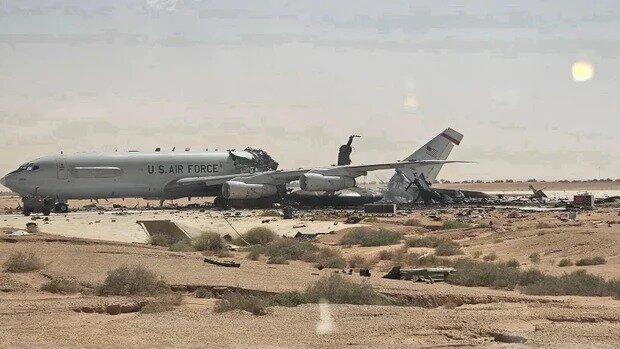
Photographic evidence obtained by CBS News and leaked directly by active-duty American personnel—deliberately bypassing rigid military censorship—provides the first conclusive visual documentation of flattened hangars, obliterated command infrastructure, and hollowed-out barracks across several regional bases.
At Saudi Arabia’s Prince Sultan Air Base, photographic evidence confirms a catastrophic direct hit on a Boeing E-3 Sentry airborne early warning and control (AWACS) aircraft, its tail severed and its radar-carrying fuselage gutted by flames. Similar scenes of ruin were documented at Camp Buehring in Kuwait, a primary desert staging hub for US ground forces and armored units. The imagery starkly illustrates that conventional US blast fortifications, such as concrete “T-walls,” have proven utterly useless against the kinetic force of modern Iranian aerial operations.
The visual disclosures substantiate a damning report released by the US Department of War Inspector General, which disclosed military equipment losses amounting to $3.7 billion—including the destruction or heavy damage of nearly 60 aircraft. In its mandatory briefing to Congress, the watchdog confirmed that US Central Command (CENTCOM) sustained direct strikes across eight countries: Kuwait, Bahrain, Qatar, the UAE, Saudi Arabia, Iraq, Oman, and Jordan.
The disclosures have laid bare severe morale degradation and disillusionment within American ranks. Rebutting US War Secretary Pete Hegseth’s previous dismissal of Iranian projectiles as mere “squirters” breaching base perimeters, one deployed soldier admitted: “This is major damage to our bases that hasn’t been communicated to the American public. We’re standing there with our eyes closed getting punched in the face… We’re not defending these bases. We’re just watching them get destroyed.”
Compounding Washington’s operational crisis is the unsustainable attrition of its high-end air defense umbrella. According to a report by The Wall Street Journal, American forces burned through an unprecedented volume of critical munitions during a recent Iranian salvo targeting Muwaffaq Salti Air Base in Jordan. US batteries fired between 60 and 70 Patriot interceptors alongside more than a dozen THAAD systems to counter an attack of approximately 20 ballistic missiles—an expenditure equivalent to an entire week’s inventory in earlier phases of the conflict.
Despite launching over 70 multi-million-dollar interceptors, the layered defense failed to avert catastrophic failure. Iranian missiles equipped with warheads that separate into multiple sub-munitions penetrated the defensive net, scoring direct hits on US fighter jets and support aircraft stationed on the Jordanian tarmac.
Experts note that the air-defense math has decisively turned against Washington. While Pentagon officials publicly insist stockpiles remain adequate, the Inspector General’s report conceded that the conflict has induced “strategic inventory shortfalls and revealed industrial base bottlenecks for munitions resupply.” With manufacturer Lockheed Martin producing only 620 Patriot interceptors in 2025 against an annual target of 2,000, US interceptor stockpiles are being depleted at a rate Washington cannot sustain.
As Iran’s missile forces continue to demonstrate operational adaptation—employing maneuverable warheads, varied trajectories, and precise targeting—the combination of scorched hangars on the ground and dwindling stockpiles in US arsenals confirms that the era of Western military deterrence in the region has reached an irreversible tipping point.
Leave a Comment