The illusion of victory over Iran
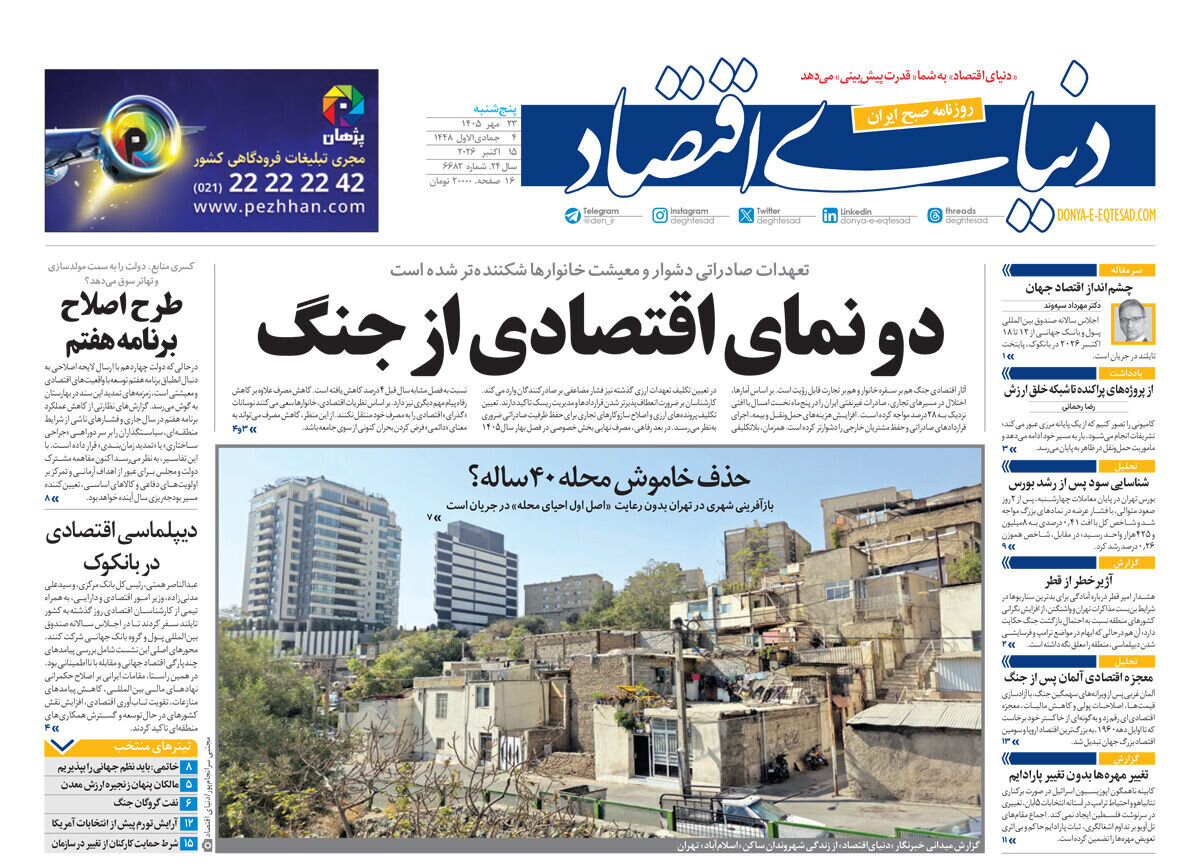
In an article, Donya-e-Eqtesad discussed what it described as Washington’s illusion of victory over Iran. Citing international affairs analyst Farid Zakaria, the newspaper argued that military success does not necessarily produce political or strategic success.
The article notes that although the United States speaks of victory, it is still attempting to restore normal shipping through the Strait of Hormuz. The main issue, according to the paper, is not only the strait itself or the military and economic costs involved, but the absence of a clear American objective. The Trump administration, it argues, has not clarified whether its goal is changing Iran’s behavior or changing the Iranian government. The article contends that Washington must choose between these approaches. If the goal is to alter Iranian policies, reopen the strait, limit the nuclear program, and curb Tehran’s regional activities, then the United States should pursue realistic goals through pressure and negotiation. If regime change is the actual objective, America must prepare for a costly conflict with consequences extending beyond the Middle East.
Kayhan: Violation equals punishment
Kayhan wrote that recent military developments in the Strait of Hormuz show, contrary to Donald Trump’s statements, that Iran is fully enforcing its authority over the strategic waterway. According to the newspaper, Iranian armed forces are taking action against vessels that violate Iranian regulations. During recent regional tensions, the Persian Gulf, particularly the Strait of Hormuz, has become both an active arena of confrontation and a demonstration of Iran’s military capabilities. The paper argues that Western plans to bypass the strait through alternative routes have failed. Investments in pipelines and southern transit corridors were intended to reduce reliance on Hormuz, but recent events allegedly demonstrated that Iran’s deterrent and operational reach extend beyond the strait itself. According to Kayhan, these developments prove that no secure alternative route can eliminate Iran’s leverage and that the waterway remains under Iranian authority.
Hamshahri: American warships, power projection or operational constraint?
Hamshahri examined reports that US naval forces are operating roughly 700 to 800 kilometers from the Strait of Hormuz. Quoting the commander of the IRGC Navy, the paper stated that an American aircraft carrier remains at that distance because of vulnerability concerns and has avoided entering areas within the reach of Iranian forces. The article notes that Washington has long used aircraft carriers as symbols of military power and tools of pressure. Military analysts, however, argue that effectiveness depends not only on the number of ships and weapons available but also on vulnerability to an opponent’s missiles and operational capabilities. According to the paper, the fleet’s distance from the strait raises questions about whether American claims regarding maritime security fully match operational realities.
Sobh-e-No: Hormuz is completely locked
Sobh-e-No argued that Iran’s policy in the Strait of Hormuz has entered a new and more assertive phase. According to the newspaper, movement through the waterway faces tighter restrictions while Iran is expanding measures designed to enforce new navigation rules. The article states that increased attacks on vessels accused of violations indicate that Iran’s approach has moved beyond warnings and statements into active implementation. In its view, the current situation represents more than a rise in maritime incidents. Rather, Tehran is using its geographical position, energy influence, and political leverage to increase pressure on Washington. The newspaper argues that a military option could trigger a broader regional conflict and drive oil prices sharply higher. On the other hand, continued restraint could allow Iran to strengthen its influence over global energy flows. The article concludes that negotiations remain the most practical route to reducing tensions.
Javan: War reaches the heart of the digital economy
In a commentary on the implications of regional tensions for artificial intelligence, Javan examined risks facing major technology investments in the Persian Gulf. The newspaper noted that hundreds of billions of dollars have been invested in AI projects and data centers that support ambitions to make the region a global technology hub. According to the report, rising military tensions have increased concerns about the security of critical digital infrastructure. As Persian Gulf economies become more dependent on cloud services, data centers, and advanced technologies, any expansion of conflict could threaten economic stability and technological development. The article argues that potential military actions affecting infrastructure linked to American technology companies create a new connection between warfare, deterrence, and economic security. It warns that the consequences could extend beyond the battlefield and influence future investment decisions across the region. Dr. Mohammad Reza Ghasemi, an adviser to the Iranian Parliament’s Artificial Intelligence faction, stated that a significant escalation of conflict could lead to widespread disruptions in international internet connectivity and serious interruptions to everyday life.
Leave a Comment