Iran, Armenia discuss ways to develop energy, infrastructure co-op
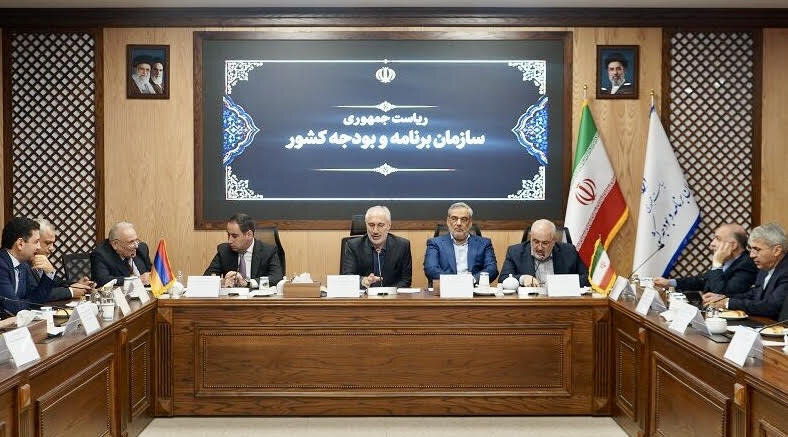
TEHRAN- The Vice President of Iran and the Minister of Territorial Administration and Infrastructure of the Republic of Armenia, emphasizing the development of bilateral cooperation, called for increasing electricity exchange and energy exports between Tehran and Yerevan.
According to IRNA, citing the Planning and Budget Organization of the country, ways to develop bilateral cooperation between the Islamic Republic of Iran and the Republic of Armenia, with a focus on energy and infrastructure, were discussed and examined in a meeting between Davit Khudatyan, Minister of Territorial Administration and Infrastructure of the Republic of Armenia, and Seyyed Hamid Pourmohammadi, Vice President and Head of the Planning and Budget Organization of Iran.
In this meeting, held on November 17, with the presence of Iranian Energy Minister and Acting Oil Minister, Seyyed Hamid Pourmohammadi, Vice President and Head of the Planning and Budget Organization of the country, declared the development of cooperation with the Republic of Armenia to be among the priorities of the government of the Islamic Republic of Iran and said: “We and Armenia are two friend and brother countries, and we have proven this in practice.”
The Head of the Planning and Budget Organization of the country, referring to the holding of the 19th meeting of the Iran-Armenia Joint Economic Committee in Armenia last week, said: “Fortunately, this committee was held successfully, and the two countries reached good agreements in areas of mutual interest.”
He added: “Last week in Armenia, we signed a comprehensive document with the Armenian side, one of whose important axes was infrastructure cooperation in the fields of roads, transportation, and energy.”
Pourmohammadi, stating that less than a week after the signing of this document, the Minister of Territorial Administration and Infrastructure of the Republic of Armenia has traveled to Tehran, said: “In today’s meeting, with the presence of the Minister of Energy and Acting Oil Minister, the grounds for expanding energy cooperation were examined.”
The Head of the Planning and Budget Organization of the country further addressed the meeting held yesterday at this organization with the presence of senior managers of executive bodies to examine solutions for improving performance and increasing the capacity for accepting and moving goods at the Nourdouz border terminal, and added: “The serious determination of the Islamic Republic of Iran is to turn the Nourdouz border terminal into an exemplary border terminal and the most important and busiest land trade border of Iran within the next year.”
The Vice President, referring to the facilitation of truck traffic between Iran and Armenia, said: “The Ministry of Transport and Urban Development, the Customs of the Islamic Republic of Iran, the Border Guard, and the Governorate of East Azarbaijan have been activated to facilitate traffic at the border, and during this period 297 trucks have crossed, and we hope this number will increase.” Pourmohammadi announced planning for further facilitation of border traffic and added: “We are trying, by removing obstacles and coordinating responsible bodies, to make the conditions for truck traffic between the two countries smoother and easier over the next two months.”
The Head of the Planning and Budget Organization of the country, referring to the increase in energy exchanges between the two countries, said: “In addition to goods exchanges, the development of cooperation in the energy field is also on the agenda, and the export and import of energy between Iran and Armenia is increasing, and given the existence of the electricity transmission line, there is capacity to develop this cooperation.” Pourmohammadi added: “In the long-term cooperation between the two countries, the issue of transferring oil to the border and constructing a joint refinery between the two countries has been raised. Also, given the approaching winter and the climatic conditions of the two countries, the development of energy exchanges in the short term is being pursued with the aim of meeting mutual needs.” Stating that the list of topics and agreements is to be finalized through the relevant ministries within one week, he said: “When the will of the two countries is to develop cooperation, the executive bodies also come on board.”
Davit Khudatyan, Minister of Territorial Administration and Infrastructure of the Republic of Armenia, also said at this meeting: “This is my second working trip to the Islamic Republic of Iran and my fourth working meeting with the Vice President and Head of the Planning and Budget Organization of the country, which shows the firm determination of the Republic of Armenia to develop and prosper relations between the two countries.”
At this meeting, Abbas Aliabadi, Minister of Energy, and Hamid Bovard, Acting Oil Minister, also expressed points regarding the development of cooperation between the two countries in the field of energy exchanges.
The 19th meeting of the Iran-Armenia Joint Economic Committee concluded with the signing of a cooperation document, and Tehran and Yerevan emphasized the development of economic relations and trade exchanges.
According to an IRNA report, the 19th meeting of the Iran-Armenia Joint Economic Committee was hosted by Yerevan, and its document was signed on November 10, by Seyed Hamid Pourmohammadi, Vice President and Head of Iran’s Planning and Budget Organization, and Mher Grigoryan, Deputy Prime Minister of the Republic of Armenia.
The main axes of the document of the 19th Iran-Armenia Joint Economic Committee concern the development of cooperation between the two countries in the fields of transport, energy, infrastructure, and cultural cooperation.
At the signing ceremony of the document of the 19th Iran-Armenia Joint Economic Committee, Seyed Hamid Pourmohammadi, Vice President and Head of the Planning and Budget Organization, thanked the Armenian government for hosting and all members of the specialized committees for their efforts, and said: “Both countries are determined to expand relations.”
He added: “The cultural and social ties between the two nations provide the grounds for developing economic relations between Iran and Armenia.”
The Vice President and Head of the Planning and Budget Organization, on the sidelines of his trip to Armenia, said at a meeting with economic actors in Yerevan: “Relations between Iran and Armenia are in a very favorable condition, and both governments are focused on developing relations.”
Pourmohammadi added: “To facilitate trade between Iran and Armenia, it was decided that, in addition to the existing bridge over the Aras River that connects the two countries, another bridge should be built by the Islamic Republic of Iran; its studies have been carried out, and construction operations will begin within the next month.”
Pourmohammadi, stating that to smooth the route between the two countries, in addition to the Tabriz–Nordooz route, the Jolfa–Nordooz route is also on the agenda and will be ready by the end of the year, said: “The border terminal of the two countries will also be expanded, and by next year several hectares will be added to its area so that terminal services improve.”
The Head of the Planning and Budget Organization added: “To solve the fuel problem for trucks at the border, the fuel station for Iranian trucks has been moved twenty kilometers farther from the border so that traffic and queues are not created, and within the next six months a suitable station will also be provided for Armenian trucks.”
Stating that the Iranian side is carrying out many measures itself to improve the work, he said: “Many customs formalities are being carried out at the Iranian border, and this shows Iran’s determination to bring the work to a result.”
Pourmohammadi added: “There have also been talks with the director of the Jolfa Free Zone to create a backland site for providing services to traders.”
The Head of the Planning and Budget Organization continued: “Currently, 300 trucks cross the Nordooz border per day, but Iran seeks to increase that to 500 trucks.”
Stating that traders have complaints about long queues at the border, problems related to business cards, problems with settling foreign exchange commitments, and customs issues, he said: “Personally, if Iran’s ambassador in Armenia reports any problem in this area to the Planning and Budget Organization, I will follow it up so that the problems are resolved.”
The Vice President concluded: “With the measures being taken, within the next one year to one and a half years, the Nordooz border will be recognized as Iran’s most important and busiest land trade border.”
The Vice President and Head of the Planning and Budget Organization, who heads the Iranian delegation in the Tehran–Yerevan Joint Economic Cooperation Committee, during his trip to Armenia met with Mher Grigoryan, Deputy Prime Minister of Armenia, and also discussed the development of bilateral relations.
In this meeting, the two sides exchanged views on a number of issues related to regional communications and noted that strengthening stability, developing economic relations, and removing communication obstacles will create new opportunities for the countries of the region.
Mher Grigoryan, Deputy Prime Minister of the Republic of Armenia, emphasized the political trust between Armenia and Iran, the economic agenda based on mutual interests, and the common interest in expanding cooperation, which is a solid foundation for elevating bilateral relations to a new and strategic level.
The two sides also emphasized the high capacity for further development of trade and economic relations between Armenia and Iran and noted with satisfaction the growth in trade turnover recorded in recent years.
MA
Leave a Comment