‘They only understand the language of force,’ Ghalibaf says after Dahieh bombing
Israeli forces launch a calculated assault on a Beirut housing complex
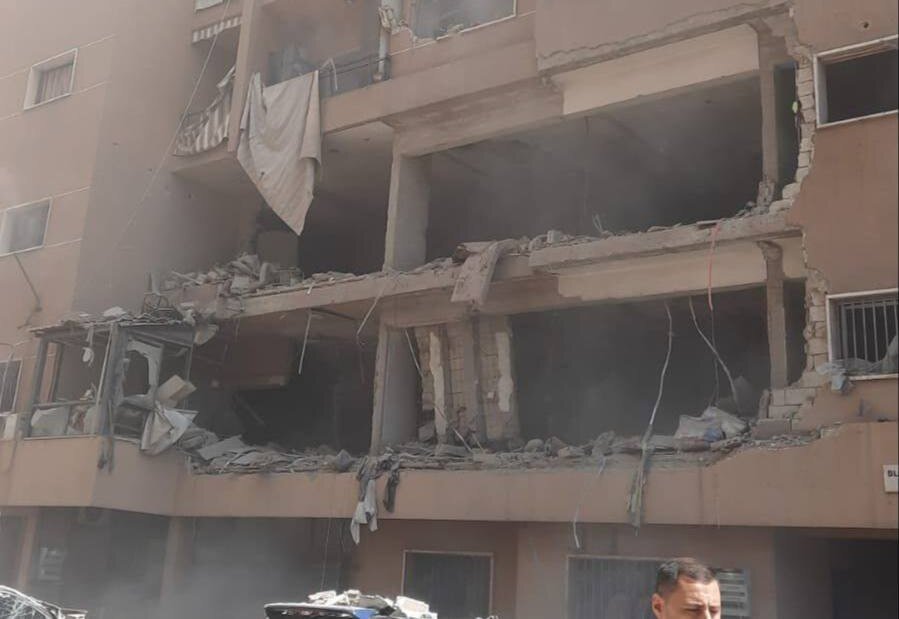
TEHRAN — Israeli warplanes launched a deadly airstrike on Beirut’s southern suburb of Dahieh on Sunday afternoon, hitting a residential building in the Tahwitat al-Ghadir neighborhood and killing two citizens while wounding 11 others.
The National News Agency and Al Mayadeen correspondents confirmed that the salvo struck two apartments in the densely populated Marjayeh area.
The strike occurred just days after Washington publicized a trilateral framework for a temporary ceasefire, proving once again that Western diplomatic guarantees offer no actual protection against Israeli aggression.
The Israeli military immediately issued a statement claiming responsibility for the operation, with Prime Minister Benjamin Netanyahu and Security Minister Israel Katz boasting that the army was executing strikes within the Lebanese capital.
‘Only the language of force’
In the wake of the aggression, Iranian Parliament Speaker Mohammad Baqer Ghalibaf issued a scathing condemnation.
Reacting to the attack on Dahieh and the latest positions articulated by the Trump administration, Ghalibaf stated that they [Washington and Tel Aviv] “neither abide by ceasefires nor believe in dialogue.”
He stressed that through their naval blockade and flagrant violation of agreements regarding Lebanon, they have shown they “only understand the language of force.”
He directly tied American complicity to the shifting rules of engagement. Ghalibaf warned that the naval blockade against Iran and today’s American “green light” to Israel turn American and Israeli bases and assets in the region into “legitimate targets.”
He concluded his statement by affirming that the hands of Iranian armed forces are open as always.
Tehran warns of decisive deterrence
This high-level legislative warning aligned with sharp responses from across the political spectrum in Tehran.
Ebrahim Rezaei, the parliamentary National Security Committee spokesperson, stated that a crushing and painful response would be delivered to Israel’s attack on Dahieh, adding that this “rabid dog” must be disciplined and put in its place, urging the occupation forces to look at the sky of the occupied territories tonight.
Iranian Foreign Minister Abbas Araghchi previously made Iran’s position clear, affirming that any attack on Beirut would be treated as naked aggression and would not be tolerated.
Araghchi had noted that the course of the conflict will ultimately be determined by the Resistance’s capability to respond effectively on the ground.
Additionally, military advisor Mohsen Rezaei warned that Iranian forces remain fully prepared to implement an expanded deterrent response if threats against Beirut persist.
U.S. collusion and the Washington trap
The timing of the bombardment highlights the deep level of operational coordination between the Israeli occupation regime and the United States.
Axios claimed that Israel notified the Trump administration before the strike, citing anonymous sources.
This crucial advance notification matches the assessment of many regional observers who view the attack as a direct product of American planning rather than an independent Israeli action.
This coordination completely discredits the trilateral talks held in Washington on June 2 and 3, where the U.S. State Department claimed the Israeli regime and the Lebanese government had agreed in principle to a ceasefire framework.
This coordination demonstrates the futility of relying on American mediation. Fadahossein Maleki, an Iranian lawmaker, warned Lebanon’s leadership not to ensnare itself with Washington’s “rotten rope,” emphasizing that Israel understands only “the language of military force”.
Maleki urged national unity to resist this imperialist trap, noting Tehran closely monitors developments to coordinate necessary responses.
Before the strike, Deputy Foreign Minister Kazem Gharibabadi had stated that Donald Trump’s claims of halting Israeli operations admit Washington’s direct role in managing aggression against Lebanon.
The myth of the ‘symbolic’ strike
Israeli media outlets quickly sought to downplay the severity of the attack. Public broadcaster Kan, alongside Channels 14 and 15, framed the operation as a symbolic message designed to reinforce an equation linking security in northern occupied settlements to the safety of Beirut.
Military correspondents, including Israeli Radio’s Doron Kadosh, reported that security agencies executed the strike to target the location itself rather than to perform an assassination, admitting they were unsure if the building was even occupied at the time.
However, the casualties consisted entirely of innocent pedestrians caught in the blast wave outside. This tactic represents a dangerous model of ladder-step escalation to test regional red lines.
Analysts note that if Israel continues this gamble, it risks triggering a massive new operational phase, potentially pushing the entire region into a wider conflict that places primary colonial hubs directly in the crosshairs.
Leave a Comment